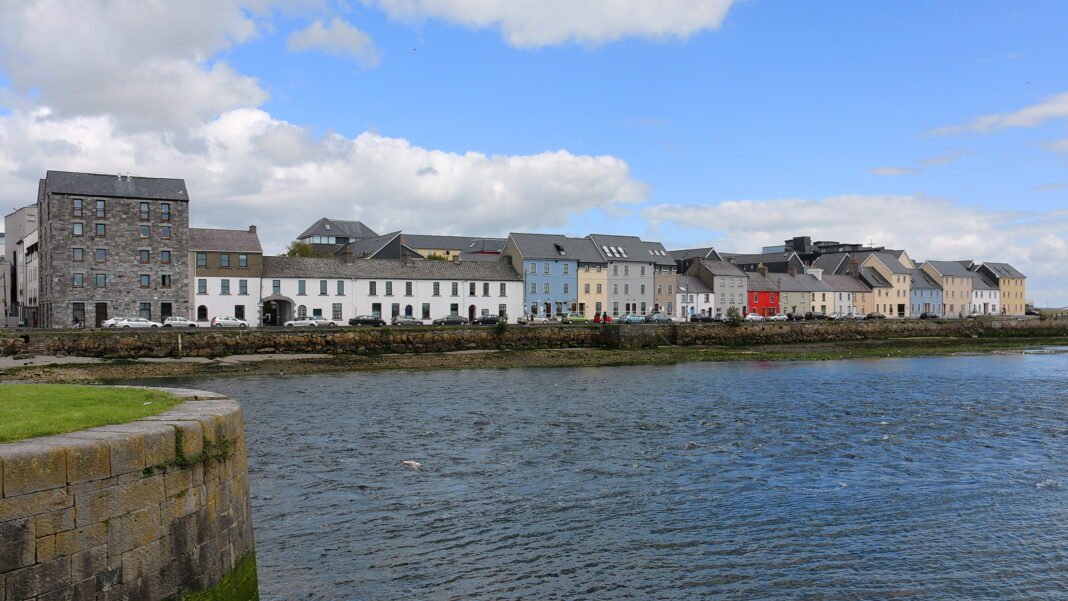


Galway feels open and easy-going today, but the medieval town was a very different place. Stone walls, guarded gates and a busy river port defined where the town ended and the wider Gaelic landscape began. Most of those defences have vanished from street level, yet fragments still survive in some wonderfully unexpected places — including inside a shopping centre.
This is the story of how Galway became a walled Atlantic town, what happened behind its gates and where you can still find the old city today.
Before the walls: a strategic river crossing
The mouth of the River Corrib offered two things that mattered enormously in the Middle Ages: access to the rich lands around Lough Corrib and a sheltered route into Galway Bay. Control of this crossing meant control of trade, movement and taxation. Following the Anglo-Norman expansion into Connacht in the 13th century, the de Burgo family established its power here and helped turn a riverside settlement into an organised town.
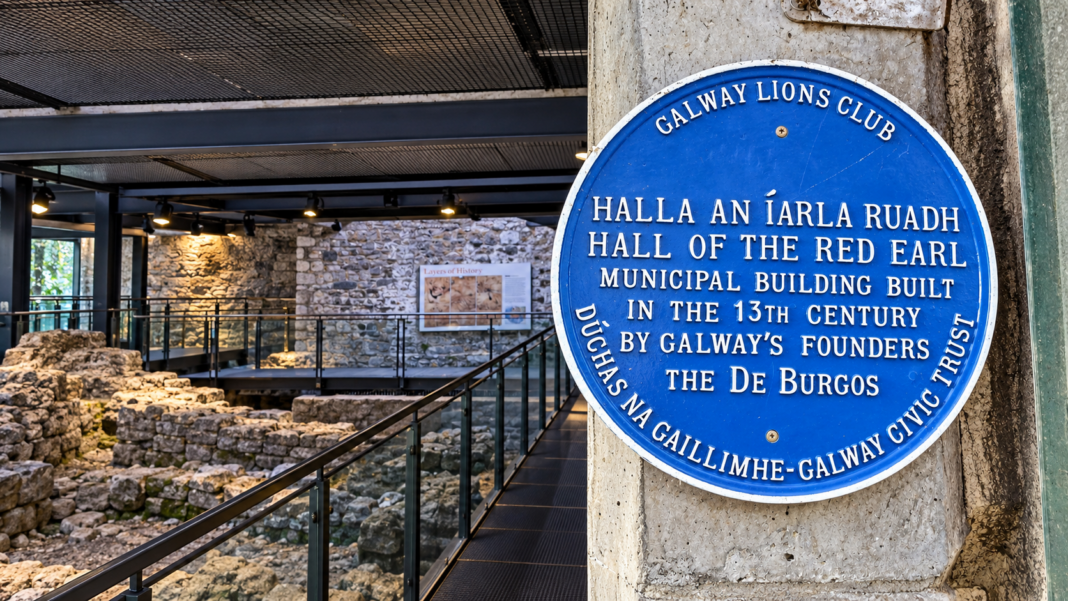
The archaeological remains at the Hall of the Red Earl belong to this early chapter. Built in the 13th century, the hall functioned as an administrative centre long before Galway’s famous merchant families reached the height of their influence.
Why Galway built a wall
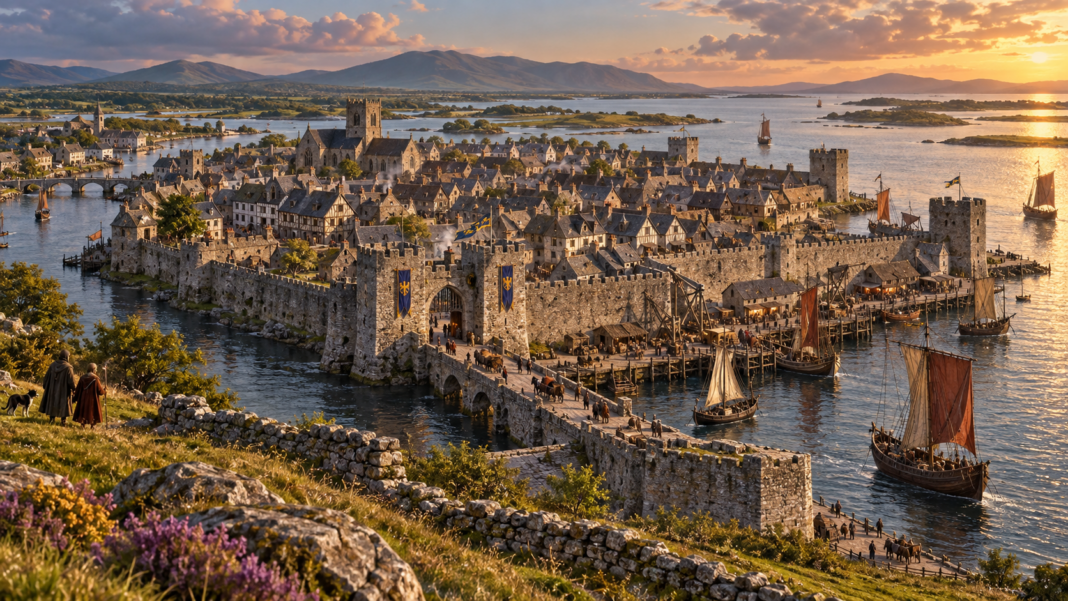
Galway City Museum records that construction of the town walls had begun before 1272. The project developed over generations, and most — perhaps all — of the town was enclosed by the early 15th century. A wall was not simply a military barrier. It controlled who and what entered the town, protected valuable goods and announced Galway’s growing status.
Gates stood on the main routes, while towers strengthened vulnerable points. At night, the entrances could be closed. During the day, carts, livestock, traders, sailors and travellers squeezed through them. Inside was a compact world of narrow streets, workshops, churches, warehouses and tall stone merchant houses.
A merchant city facing the Atlantic
Galway’s prosperity came from the water. Its merchants traded with ports in Ireland, Britain and continental Europe, especially France and Spain. Wine was one of the best-known imports, while hides, wool, fish and other goods moved out through the quays. The familiar nickname “City of the Tribes” refers to fourteen merchant families whose names became closely associated with civic power in later medieval and early modern Galway.
It is tempting to imagine the town as isolated behind its walls, but the opposite is closer to the truth. The defences protected a place that was outward-looking, commercially ambitious and filled with news from ships arriving across the Atlantic world.
What did the medieval city look like?
The walled town was much smaller than modern Galway. Its street plan centred on the commercial spine running through the area visitors now know as the Latin Quarter. St Nicholas’ Collegiate Church stood at its heart, while the river and quays shaped the western edge.
Do not picture one perfectly uniform wall. It was repaired, strengthened and extended over time. The waterfront defences continued to evolve as trade changed. The section now called the Spanish Arch belongs to a later 1584 extension that protected the quays, but it helps visitors understand how closely Galway’s fortunes were tied to the river and sea.
How the walls disappeared
As Galway expanded and older fortifications lost their military purpose, walls became obstacles rather than protection. Sections were removed, absorbed into newer buildings or simply forgotten. Stones were reused. Streets pushed beyond the old boundary. By the modern era, much of the medieval circuit had disappeared from view.
That disappearance is part of what makes the surviving fragments so fascinating. They are not displayed in one tidy open-air museum. Instead, medieval Galway appears in pieces: behind shopfronts, beneath later buildings, beside modern walkways and in archaeological sites tucked just off busy streets.
Where to see Galway’s old walls today
- Eyre Square Centre: the most surprising surviving section runs through the modern shopping centre. The contrast between ancient stonework and glass-and-steel retail space makes the scale of the old fortification unusually easy to appreciate.
- Spanish Arch: this later waterfront extension is the city’s best-known surviving defensive structure and a natural stop beside Galway City Museum.
- Hall of the Red Earl: not a section of wall, but an essential archaeological site for understanding the 13th-century town that grew into walled Galway.
- St Nicholas’ Collegiate Church: the church and surrounding lanes help reveal the compact scale of life inside the medieval town.
A short self-guided history walk
Start at the wall inside Eyre Square Centre, then walk down Shop Street towards St Nicholas’ Collegiate Church. Continue through the Latin Quarter to the Hall of the Red Earl on Druid Lane, and finish at the Spanish Arch and Galway City Museum. The route is short, but allow 60–90 minutes so you can stop and look properly.
The best trick is to forget the modern shopfronts for a moment and watch the street widths. Medieval Galway survives not only in individual stones, but in the shape of the city itself.
Good to know
- Best for: history lovers, architecture fans and a rainy-day city walk.
- Cost: the visible wall sections and outdoor landmarks can be seen free of charge.
- Accessibility: modern access varies by location; check individual venues if step-free access is essential.
- Photography: the wall inside Eyre Square Centre is particularly striking because old and new Galway appear in the same frame.
Map: medieval wall inside Eyre Square Centre
Frequently asked questions
Can you walk the complete medieval wall?
No. The full circuit no longer survives as a continuous structure. A walking route links scattered remains and places that explain the old town.
Is the Spanish Arch medieval?
It forms part of a later extension of Galway’s defences, constructed in 1584 to protect the quays. It is best understood as a continuation of the walled city’s waterfront story.
Where is the most unexpected surviving section?
Inside Eyre Square Centre, where a substantial stretch of old wall has been incorporated into the modern shopping complex.