

Accessible transport in Galway is easier to arrange when you plan the exact journey rather than relying on a general promise of accessibility. The centre is compact, but historic paving, kerbs, crowds, gradients and changing weather can make two apparently similar routes feel very different.
Start with the exact address
“Galway city centre” covers several streets on both sides of the River Corrib. Before travelling, check the entrance to your hotel, restaurant or attraction and not only its postcode. Ask the venue about steps, doorway width, lifts, accessible toilets and the closest suitable drop-off point. Temporary street works can alter an otherwise manageable route.
Accessible city buses in Galway
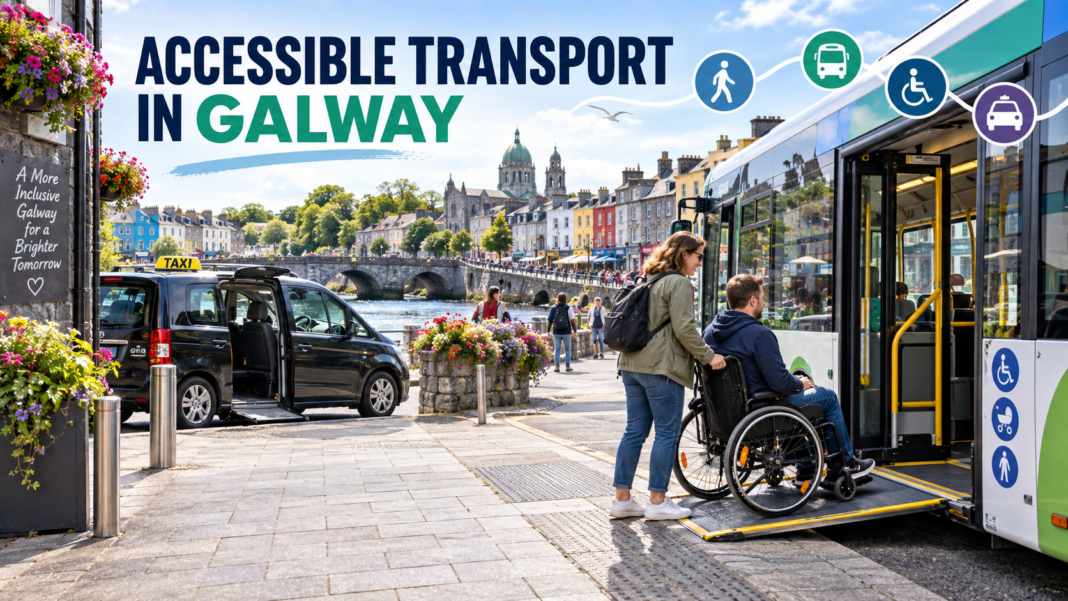
Low-floor vehicles operate on many urban services, but the vehicle used, stop layout, boarding space and ramp availability can vary. When step-free boarding or a mobility space is essential, confirm the particular journey with the operator and leave enough time to speak with the driver.
Stops around Eyre Square are close together but do not all serve the same routes or directions. The official TFI Journey Planner helps identify the correct stop and current service. Our Galway City bus guide provides additional local planning advice.
Wheelchair-accessible taxis
A wheelchair-accessible taxi can provide direct travel when a bus stop or walking route is unsuitable. Supply may be limited during busy periods, so book in advance where possible. Describe the wheelchair or mobility equipment, the number of passengers and the assistance required, then ask the provider to confirm that the allocated vehicle is appropriate.
Licensed taxi fares are metered and regulated nationally. The final amount still depends on distance, time, traffic and applicable extras. For an important appointment or early departure, build in a time margin rather than estimating the journey only by distance. See our Galway taxi guide for more detail.
Arriving at Galway Ceannt Station
Ceannt Station is beside Eyre Square, making it a convenient arrival point for central Galway. Irish Rail provides passenger assistance, but travellers who need help boarding, leaving the train or navigating the station should follow the current booking procedure and allow extra time.
Station redevelopment can change the usual entrance, platform route or meeting point. Check current information before departure and follow on-site signs. If the final destination is beyond easy walking distance, arrange a suitable taxi rather than waiting until arrival. Our Ceannt Station guide explains the surrounding area.
Moving around Galway city centre
Shop Street and much of the retail core are pedestrianised, which removes through traffic but not every obstacle. Surfaces include paving, drainage channels and occasional kerbs, while deliveries and large crowds can reduce the available width. Quieter morning periods may be more comfortable than a busy Saturday afternoon.
Eyre Square, the Latin Quarter, Spanish Arch and Claddagh are geographically close, yet rivers, bridges and slopes affect the practical route. Preview the route on a map and ask the destination about the most accessible entrance. Do not assume the shortest line is the easiest journey.
Visiting Salthill Promenade
Long sections of Salthill Promenade are relatively level and open, with sea views and places to pause. The exposed location is the main complication: Atlantic wind and rain can make the return journey harder than expected. A bus or pre-booked taxi gives you a useful alternative if conditions change.
Travelling with visual, hearing or hidden disabilities
Accessibility is not limited to step-free travel. Ask operators and venues about announcements, written information, assistance points, seating and quieter times. Keep essential journey details on your phone and in a second format if possible. A companion or staff member may find it easier to assist when you explain the specific barrier rather than using only a general request.
A practical backup plan
- Confirm essential assistance directly with the operator or venue.
- Save the exact address and accessible entrance.
- Avoid peak commuter and weekend shopping periods where possible.
- Keep a taxi number or booking option as a backup.
- Allow for rain, wind and temporary street works.
- Carry necessary medication, charging equipment and contact details with you.
Quick transport comparison
| Option | Potential advantage | Confirm in advance |
|---|---|---|
| City bus | Useful for regular urban routes | Vehicle, stop and boarding suitability |
| Accessible taxi | Direct door-to-door journey | Vehicle type and equipment space |
| Train | Central arrival beside Eyre Square | Passenger assistance and station route |
| Walking or wheeling | Compact central distances | Surfaces, kerbs, gradients and entrances |
Frequently asked questions
Are all Galway buses wheelchair accessible?
Many journeys use low-floor accessible vehicles, but operational substitutions and stop conditions can vary. Confirm the exact service when accessibility is essential.
Is Galway city centre flat?
Much of the central area is manageable, but paving, kerbs, bridges and slopes near the river mean the easiest route depends on the destination.
Should I book an accessible taxi?
Yes, particularly at busy times or when a specific vehicle configuration is required. Explain your equipment and assistance needs while booking.
Accessible Galway map
Use the map as a starting point, then confirm current step-free access with the transport operator or venue before travelling.