

Driving to Galway makes sense if Connemara, small coastal villages or rural day trips are central to your plans. For a short city break, however, the car may spend most of its time in a paid space while you explore on foot. Decide what the vehicle will actually add before accepting the cost of hire, fuel, tolls and parking.
A little preparation makes the final approach much calmer. Save your accommodation address, confirm where you can legally stop or park, and check live traffic before setting off rather than relying on the first journey time shown by a navigation app.
Main approaches to Galway
The M6 is the principal route from Dublin and the east. Traffic arriving from Limerick and Shannon generally uses the M18, while journeys from Mayo, Sligo and Connemara include national and regional roads. Conditions can change with weather, roadworks, commuter traffic and major events, so check an official traffic source on the day.
Understand tolls before the journey
Some motorway journeys in Ireland involve tolls, but the charge and payment method depend on the road. The M50 around Dublin uses barrier-free tolling, which catches out drivers expecting a booth. Check current information from the official road or toll operator, especially if your route passes Dublin.
With a hire car, ask the rental company exactly how tolls are handled. Some firms pass charges on automatically, while others expect the driver to pay and may add an administration fee. Do not assume the policy is the same as the last company you used.
Driving safely in Ireland
Traffic drives on the left, and speed limits in the Republic of Ireland are displayed in kilometres per hour. Outside the main roads, expect narrow bends, limited sightlines and space shared with cyclists, walkers, farm vehicles and animals. A posted limit is not a target when the road, visibility or weather calls for a slower speed.
Stop somewhere safe before adjusting navigation. On rural routes, allow more time than the distance suggests; repeatedly pulling into verges or gateways creates its own risks.
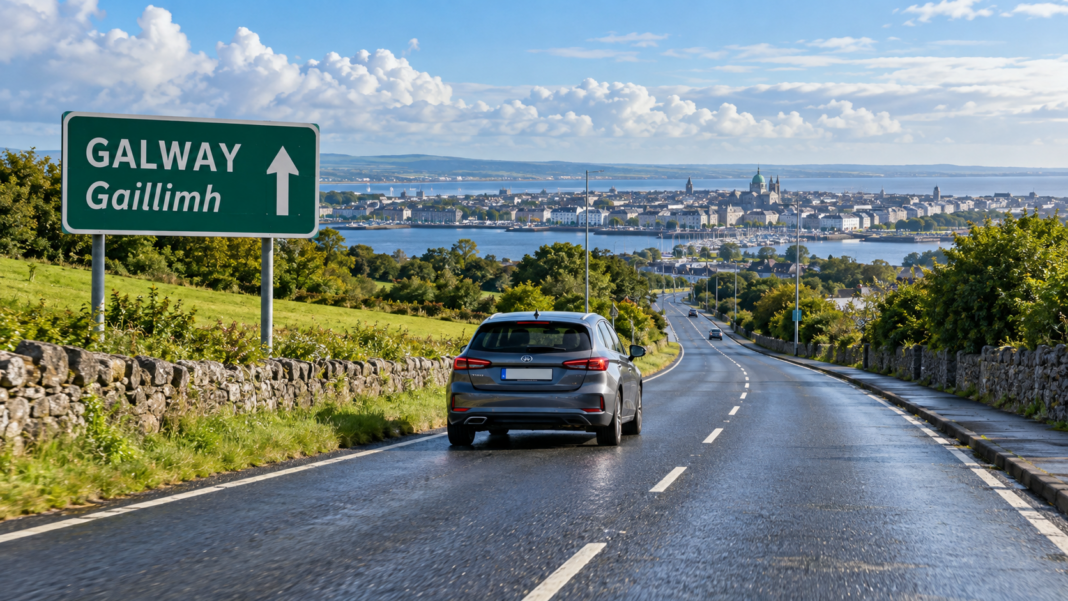
The final approach to Galway city
Traffic can build on approaches to the city during weekday peaks, Friday afternoons, festivals and large events. Add a buffer and avoid planning a restaurant booking or tour departure immediately after your estimated arrival.
If your accommodation advertises parking, confirm whether the space is guaranteed, paid, height-restricted or available only from check-in time. Ask for the recommended approach and unloading instructions; a central one-way street is a poor place to improvise with luggage.
Do you need the car once you arrive?
Most central sights, restaurants and pubs sit within a compact area. If the first part of your stay is city-based, parking the car once—or collecting it only when you leave for the countryside—can be easier than driving short distances. Our Galway without a car guide explains the walking, bus and taxi alternatives.
Parking without an expensive surprise
Galway has both on-street and off-street parking, but charges, maximum stays, overnight access and payment methods vary. Read the signs at the exact space or car park rather than copying advice from an old forum post. Keep valuables out of sight and photograph the level, street name or entrance before walking away.
For more detail, use our Galway city parking guide and overnight parking guide.
Rental-car checklist
- Confirm insurance cover, excess, fuel policy and deposit.
- Photograph the vehicle at collection and report existing damage.
- Ask how motorway tolls, parking charges and fines are administered.
- Confirm permission and insurance for Northern Ireland if crossing the border.
- Choose a car that genuinely fits passengers and luggage.
- Save the rental company’s roadside-assistance number.
- Do not begin a long drive when overtired after a flight.