

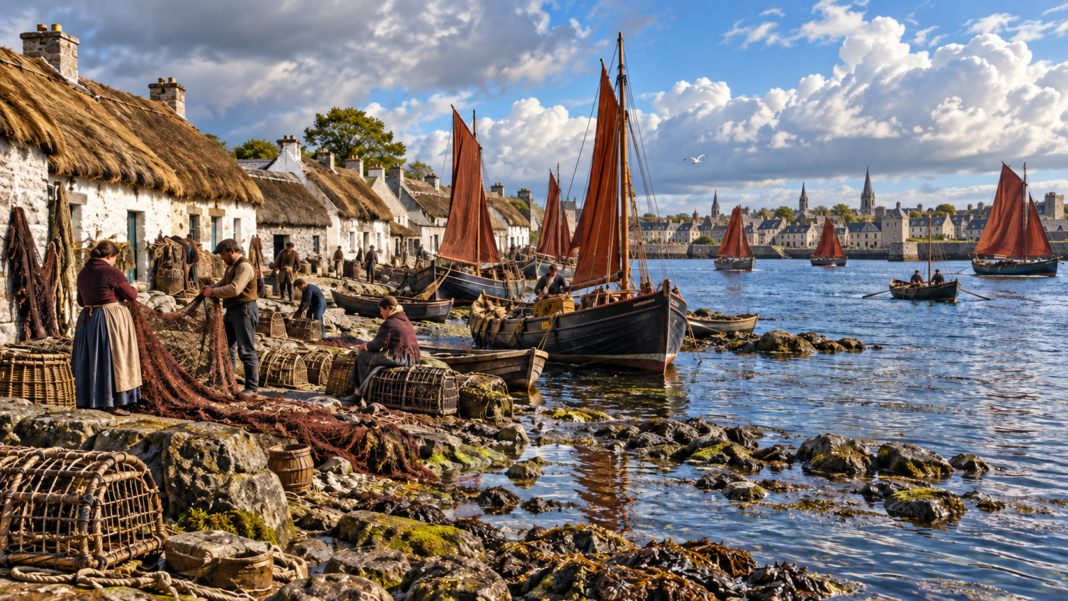
Long before the Claddagh became a sought-after Galway neighbourhood, it was a village apart. Thatched cottages crowded the stony shore, fishermen launched traditional boats into Galway Bay, and an Irish-speaking community lived within sight of the city walls while keeping its own customs and identity.
The old village is gone, but its name travelled around the world through the Claddagh ring. To understand the symbol properly, it helps to begin not in a jewellery shop, but on the western bank of the River Corrib, where generations of fishing families built a life around the tides.
What does Claddagh mean?
Claddagh comes from the Irish word cladach, meaning a stony shore. The name fits the landscape: the settlement developed where the Corrib reaches Galway Bay, directly across the river from the Spanish Arch and the old walled town.
This position placed the community close to Galway but socially distinct from it. The town’s merchants looked towards the quays and overseas trade; Claddagh families looked towards the bay, the weather and the day’s catch.
A village outside Galway’s walls
The Claddagh grew beyond the medieval defences rather than inside them. Its fishermen supplied Galway with fish and shellfish, selling their catch near the waterfront and Fish Market. Yet the community retained a strong independence, with its own traditions, leaders and informal rules.
Irish remained a living language in the village into the modern era. Visitors often described the Claddagh as a world of its own: low cottages, narrow lanes, boats drawn up near the shore and families whose knowledge of Galway Bay had passed from one generation to the next.
The King of the Claddagh
One of the community’s most famous traditions was the title “King of the Claddagh”. This was not a monarch in the usual sense. The king acted as a respected community figure associated with the fishing fleet and local order.
Accounts of the role differ across periods, and the title became increasingly ceremonial as the old fishing system declined. Even so, it captures something important: the Claddagh was not simply a poor suburb beside Galway. It understood itself as a community with its own authority, customs and collective identity.
The Galway Hooker and life on the bay
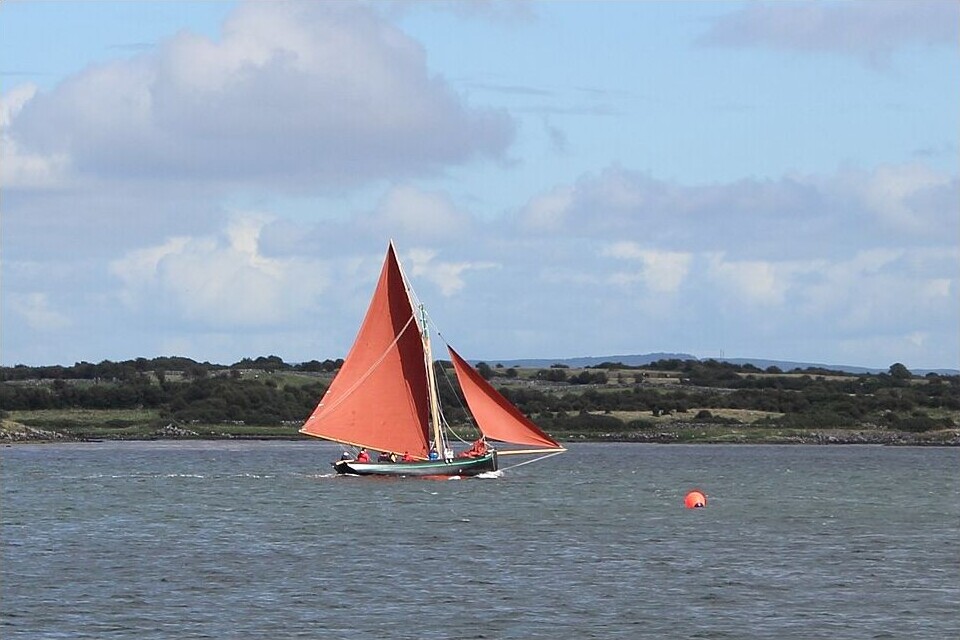
Fishing shaped the rhythm of life. Boats had to cope with Atlantic weather, shallow coastal water and sudden changes in wind. The craft most closely associated with the region is the Galway Hooker, recognisable by its dark hull and deep rust-red or brown sails.
Different sizes of traditional boats served different purposes, from fishing close to shore to carrying turf and goods around Galway Bay and between the mainland and the Aran Islands. On land, nets had to be made and repaired, catches sorted, boats maintained and weather watched constantly.
The work was dangerous. A poor season, damaged boat or storm could affect an entire household. The romantic image of red sails on Galway Bay came from a demanding working culture rather than leisure sailing.
The village behind the famous ring
The Claddagh ring — two hands holding a crowned heart — is now known internationally as a symbol of friendship, love and loyalty. Its strongest traditional connection is with the fishing village, although parts of its popular origin story belong to legend.
Galway goldsmith Richard Joyce is closely associated with some of the earliest surviving rings of this design around the turn of the 18th century. The dramatic story that he was captured by corsairs, trained as a goldsmith in North Africa and later returned to Galway is widely repeated, but not every detail can be proven.
What is certain is that the ring became deeply connected with Galway and the Claddagh community. Rings were treasured as family possessions and often passed between generations. The symbol ultimately carried the village’s name far beyond the shore where it began.
Why was the old Claddagh demolished?
By the early 20th century, the original settlement faced serious overcrowding and poor sanitation. Many cottages lacked modern services, and public health officials considered the housing unfit. During the late 1920s and 1930s, the old thatched village was cleared and replaced by a planned council housing scheme.
The change brought better housing conditions, but it also erased the physical form of a centuries-old settlement. The maze of cottages and lanes disappeared. What survived was the community name, its maritime memory and fragments preserved in photographs, museum collections and family history.
What remains today?
Modern Claddagh is a residential area only a short walk from the Latin Quarter. The shoreline, river mouth and view back towards the Spanish Arch and Long Walk still explain why the original community grew here. St Mary’s Dominican Church and the surrounding streets now define a very different neighbourhood, but the relationship with the water remains visible.
Walking the quay is less about finding intact old cottages and more about reading the landscape. Look towards Galway Bay, imagine boats hauled onto the shore, then turn back towards the old city. The short distance across the Corrib once separated two closely connected but distinct worlds.
A simple Claddagh heritage walk
Start at the Spanish Arch and cross Wolfe Tone Bridge. Follow the waterfront around Claddagh Quay, stopping for the classic view of the Long Walk. Continue towards South Park and look out over Galway Bay. Return by the same route or continue towards Salthill if the weather is good.
For deeper context, visit Galway City Museum before or after the walk. Its displays and collections help connect the Claddagh with the wider maritime history of Galway and the west coast.
Good to know before you visit
The Claddagh waterfront is free to explore and is within easy walking distance of the city centre. The route is mostly level, though surfaces and kerbs vary. It is an exposed coastal area, so wind and rain can arrive quickly. This remains a residential neighbourhood: photograph from public areas, keep entrances clear and respect local homes.
Find the Claddagh waterfront
Open Claddagh Quay in Google Maps
Frequently asked questions
Was the Claddagh originally a separate village?
Yes. It developed outside Galway’s medieval walls and maintained a strong fishing-community identity, even though it supplied the town and stood only across the river.
What happened to the old thatched cottages?
The original village was cleared during the late 1920s and 1930s after concerns about overcrowding and sanitation. It was replaced by planned housing.
Is the Claddagh ring from this village?
The ring is historically associated with Galway and takes its name from the Claddagh. Richard Joyce is linked with some of the earliest examples, although the most dramatic parts of his life story are difficult to verify fully.
Can visitors still see the old village?
No intact thatched settlement survives. Visitors can explore the historic location, waterfront and views, then use Galway City Museum to understand the community that once lived there.
Sources and image note
- Galway City Museum: The Claddagh
- Galway Tourism: The Claddagh
- Wikimedia Commons: Claddagh collection
Featured image: artistic reconstruction of the old Claddagh fishing village, created for Galway City Life. It is an illustration, not an archival photograph.