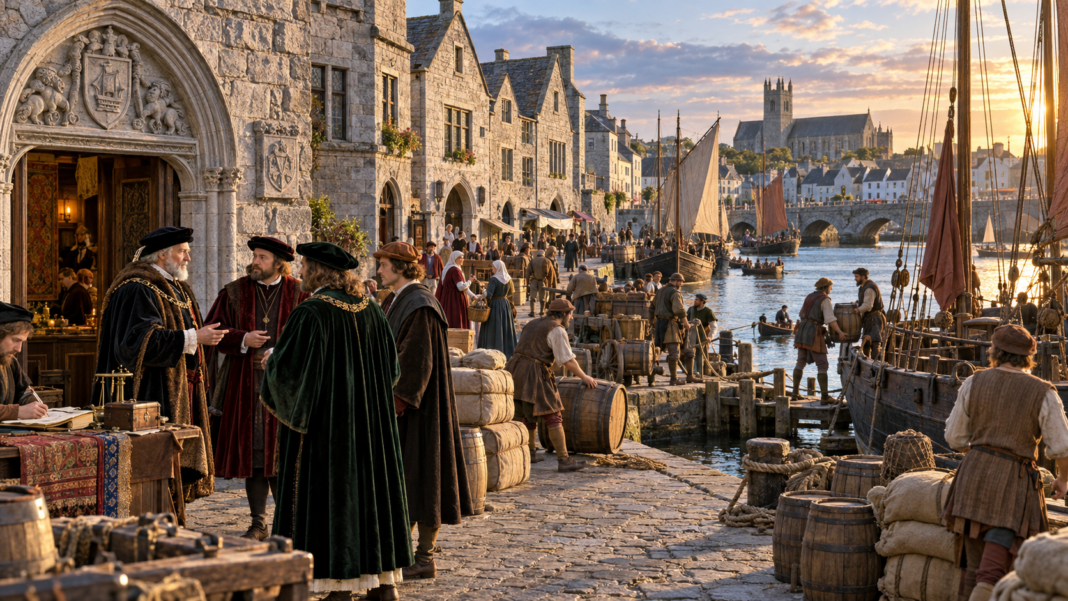


Stand beside the River Corrib at the Spanish Arch and Galway’s past suddenly feels close enough to touch. Today, the stone arches frame one of the city’s favourite meeting places. Four centuries ago, however, this was a hard-working waterfront where boats unloaded wine, salt and other goods beneath the protection of the city wall.
The name suggests a monument built by Spanish sailors. That is the first surprise: the Spanish Arch was not built by the Spanish. Its story belongs to Galway’s merchant families, its busy quays and the international trade that made the medieval city wealthy.
What exactly is the Spanish Arch?
The Spanish Arch is part of a late-16th-century extension of Galway’s medieval defences. The wall ran from the older Martin’s Tower towards the river, shielding the quays beside the Fish Market. It was built in 1584, during the mayoralty of Wylliam Martin, when Galway’s waterfront was crowded with merchants, fishermen, porters and visiting crews.
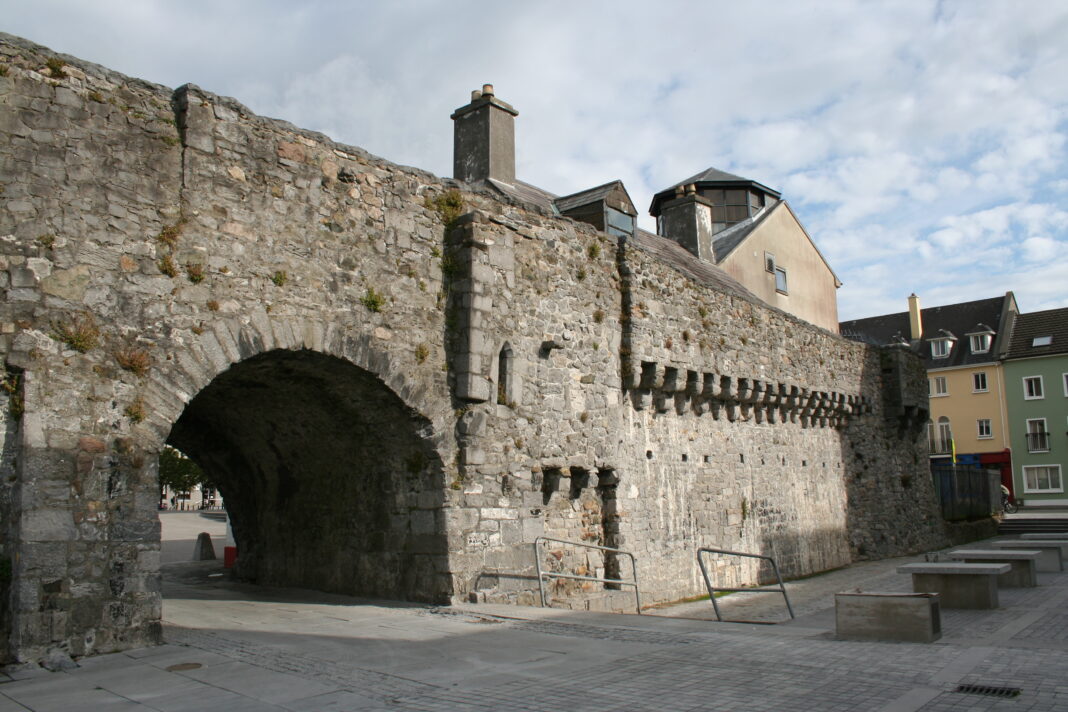
Locally, the structure was known in Irish as Ceann an Bhalla — the head, or end, of the wall. The surviving arches were practical gateways through a defensive wall rather than a ceremonial monument. People and goods passed through them between the quay and the streets of the town.
Why is it called the Spanish Arch?
The familiar name appeared later and reflects Galway’s strong trading connections with Spain. Ships sailed between Galway and ports on the Iberian Peninsula carrying hides, wool, fish and other Irish produce. They returned with wine and goods that helped shape the tastes and fortunes of the city’s merchant class.
Spanish traders did visit Galway, but there is no evidence that they designed or built the arch. Think of the name as a memory of an international trading relationship, not a record of who laid the stones.
A doorway into Galway’s merchant city
To understand the arch, picture a Galway that was enclosed by walls and governed by powerful merchant families. The city’s narrow streets led downhill towards the river and harbour. Warehouses, market stalls and boats filled the waterfront, while taxes on imported and exported goods helped to support the town.
The arch stood at the edge of this commercial world. Passing through it meant moving between the protected city and the open quay. The stonework was built for security, but it also reveals Galway’s dependence on the sea: without access to the ships outside the walls, the city could not have prospered.
What survived?
Much of Galway’s defensive wall disappeared as the city expanded. Sections were absorbed into later buildings, dismantled or simply hidden from view. At the Spanish Arch, two large openings and a stretch of heavy stonework remain clearly visible. They are among the most recognisable fragments of the old walled town.
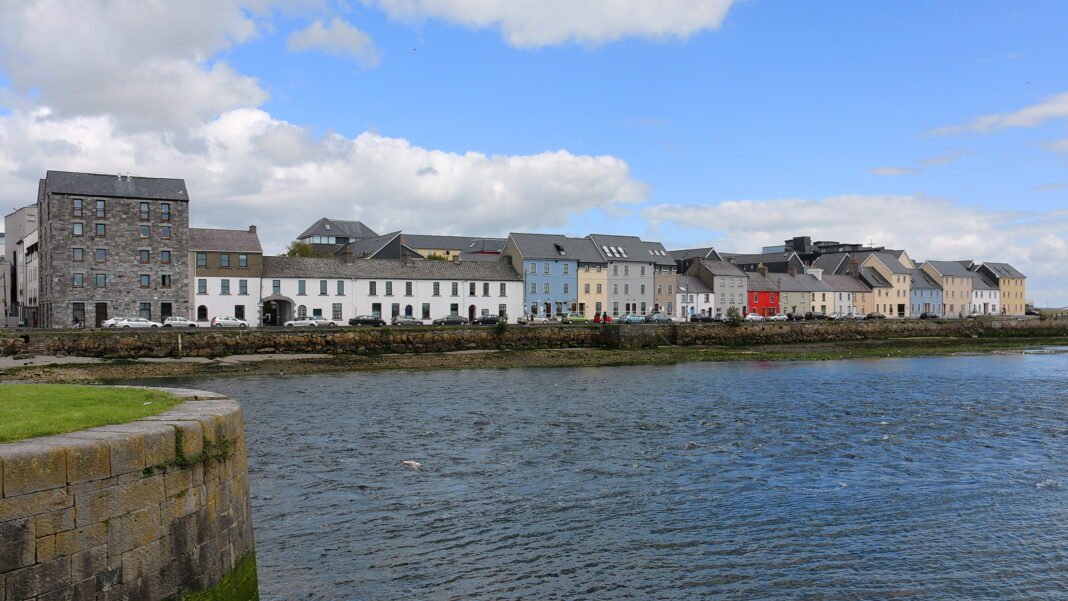
The surroundings have changed dramatically. The former Fish Market is now a public space, Galway City Museum stands nearby, and the Long Walk brings a ribbon of colourful houses to the river. Yet the basic geography still makes sense: the arch marks the point where the medieval streets met the waterfront.
What to look for when you visit
- The thickness of the wall: stand inside one of the openings and notice how substantial the stonework is.
- The river-facing position: look towards the Corrib and imagine boats unloading only a short distance away.
- The wall line: the surviving masonry helps reveal how the medieval boundary continued along the waterfront.
- The wider historic setting: combine the arch with the Long Walk, Quay Street, Kirwan’s Lane and St Nicholas’ Collegiate Church to follow Galway’s merchant story through the city.
A simple historical walk
Begin at the Spanish Arch and visit Galway City Museum, where exhibitions place the city’s archaeology and maritime history in context. Continue through the Latin Quarter towards Kirwan’s Lane, then walk to St Nicholas’ Collegiate Church and Lynch’s Castle. The route is compact, but it connects the waterfront, the merchants and the surviving traces of Galway’s walls.
Good to know before you go
The Spanish Arch is an outdoor public landmark and can be viewed at any time. There is no admission charge. The surrounding riverside area is mostly level, although old paving and busy pedestrian areas can make some sections uneven. Early morning is best for quieter photographs; around sunset, the riverfront becomes livelier and the Long Walk catches warm light.
Galway City Museum is immediately beside the arch and is the most useful next stop for anyone who wants to understand the site rather than simply photograph it. Opening arrangements can change, so check the museum’s official website before a dedicated visit.
Find the Spanish Arch
Open Spanish Arch in Google Maps
Frequently asked questions
Was the Spanish Arch built by the Spanish?
No. It was built as part of Galway’s waterfront defences in 1584. The later name recalls the city’s trade with Spain.
What does Ceann an Bhalla mean?
It means “the head of the wall” or “the end of the wall”, a practical description of the structure’s position.
Is the Spanish Arch free to visit?
Yes. It is an outdoor public landmark with no entrance fee.
How long should I allow?
Ten to twenty minutes is enough to see the arch itself. Allow longer if you add Galway City Museum, the Long Walk and a walk through the Latin Quarter.
Sources and further reading
- Galway City Museum: Medieval Galway
- Discover Ireland: Spanish Arch
- Wikimedia Commons photograph and licence details
Featured photograph: Spanish Arch in Galway by Ramón, licensed under CC BY-SA 2.0 via Wikimedia Commons.