

Galway’s best-known nickname sounds ancient and mysterious: the City of the Tribes. It does not refer to prehistoric clans or a single Gaelic kingdom. The “tribes” were fourteen merchant families who dominated the commercial, political and social life of Galway from the late Middle Ages into the 17th century.
Their story explains why a small town on Europe’s Atlantic edge became wealthy, outward-looking and surprisingly cosmopolitan — and why family names still appear on Galway streets, buildings and businesses today.
Who were the fourteen Tribes of Galway?
The fourteen families traditionally listed as the Tribes of Galway were:
- Athy
- Blake
- Bodkin
- Browne
- Darcy
- Deane
- Ffont
- Ffrench
- Joyce
- Kirwan
- Lynch
- Martin
- Morris
- Skerrett
Most were of English or Welsh origin and descended from the Anglo-Norman settlement. The Darcys and Kirwans had Gaelic roots. Over generations, the families became deeply connected to the surrounding Irish-speaking world, adopting local customs and building alliances through marriage and trade.
Why were they called “tribes”?
The name was probably not intended as a compliment. Galway City Museum notes that the term is reputed to have been coined by Cromwellian forces. It carried the suggestion that these interconnected families were a closed group, loyal to one another and resistant to outside control.
Galway later reclaimed the label with pride. “City of the Tribes” now celebrates the merchant families’ role in shaping the city rather than repeating the old insult.
How the families built their power
The Tribes did not rule through one hereditary crown. Their influence came from business, property, marriage and civic office. Family members served as mayors, sheriffs, councillors and church patrons. They commissioned buildings, financed religious institutions and controlled many of the networks that kept Galway’s economy moving.
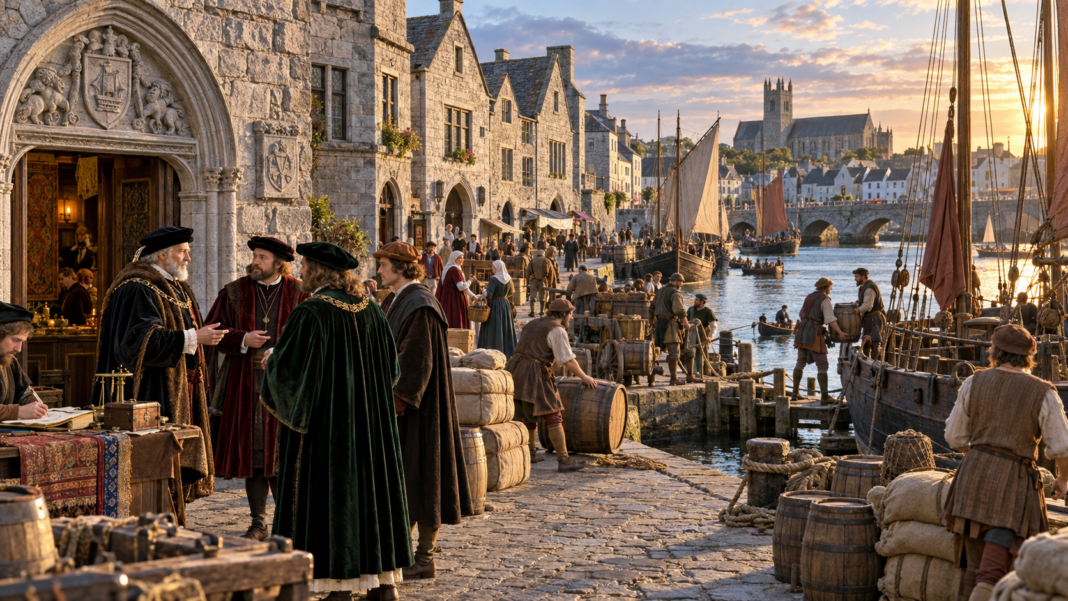
Their Galway was a compact walled town, but its ambitions reached far beyond the gates. Merchants traded with the Gaelic hinterland and with European ports, particularly in France and Spain. Wine, salt and luxury goods arrived by sea; hides, wool, fish and other local products travelled outward. Later connections stretched across the Atlantic.
Life inside a merchant house
A successful family’s home was part residence, part warehouse and part statement of status. Thick limestone walls provided security. Goods could be stored below while the family lived and entertained above. Carved coats of arms, decorative fireplaces and finely worked stone announced wealth to neighbours and visitors.
Two important fortified merchant houses survive. Lynch’s Castle, built around 1500, remains one of the most recognisable buildings on Shop Street. Blake’s Castle, dating from the 15th century, also preserves part of this urban world. Both remind us that Galway’s “castles” were not always remote fortresses; some stood directly inside busy commercial streets.
The Lynch family and Galway’s most famous legend
No Tribe is more closely associated with Galway folklore than the Lynches. A famous story claims that Mayor James Lynch FitzStephen hanged his own son from a window in 1493 after other officials refused to carry out a murder sentence.
The tale has been repeated for centuries, but visitors should treat its dramatic details cautiously. What is certain is that the Lynch family supplied numerous mayors and left a strong architectural mark on the town. The memorial known as Lynch’s Window on Market Street keeps the legend alive, while Lynch’s Castle offers much clearer evidence of the family’s real power.
The Joyces, the Claddagh Ring and a remarkable life
The Joyce family adds another irresistible story. Goldsmith Richard Joyce, associated with one of the fourteen Tribes, is traditionally credited with creating the familiar modern form of the Claddagh ring. Galway City Museum holds what is believed to be the oldest known surviving Claddagh ring, dating from around 1700.
Joyce’s life reads like an adventure: according to the historical account, he was captured by pirates, enslaved in North Africa, trained as a goldsmith and eventually returned to Galway. Whether visitors arrive for romance, craftsmanship or history, his story connects the merchant city with the wider Mediterranean world.
Why their influence faded
The 17th century brought war, political upheaval and the collapse of the old civic order. Cromwellian conquest and later changes in land ownership reduced the families’ control. Some lost property, some moved elsewhere and others adapted to the new system.
Their age of dominance ended, but their names did not disappear. They remain woven into Galway’s identity, architecture and local memory.
Where to find the Tribes in Galway today
- Lynch’s Castle: admire the exterior and its carved stone details at the junction of Shop Street and Abbeygate Street.
- Lynch Memorial Window: find the monument on Market Street and read the story with a healthy dose of historical caution.
- Galway City Museum: see objects connected with medieval and post-medieval Galway, including merchant-family material and the early Claddagh ring.
- St Nicholas’ Collegiate Church: look for memorials and traces of the families who worshipped, married and were buried here.
- Blake’s Castle: another surviving fortified townhouse linked to one of the fourteen families.
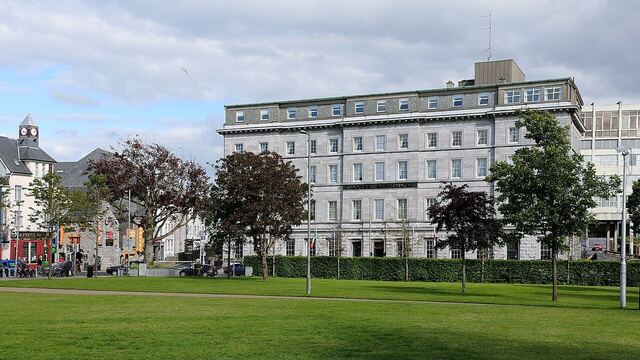
- Eyre Square: the flags and civic imagery around the square often reference the Tribes and their heraldic identities.
A short City of the Tribes walking route
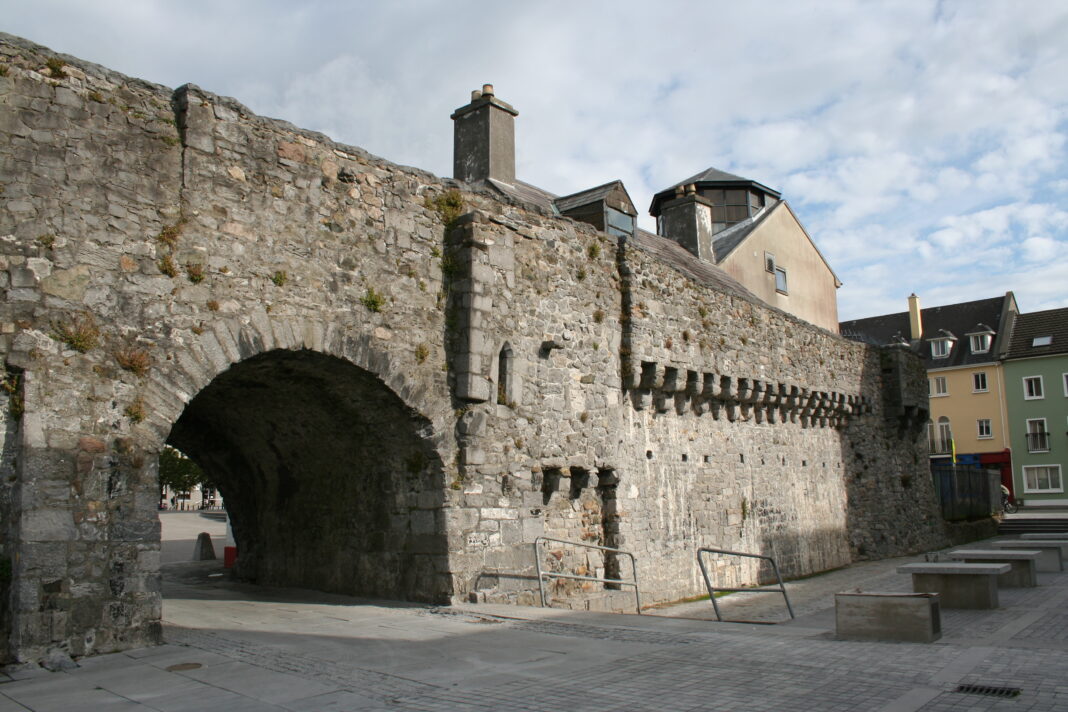
Begin at Lynch’s Castle, continue to Lynch Memorial Window and St Nicholas’ Collegiate Church, then walk through the Latin Quarter to the Spanish Arch and Galway City Museum. The route takes about 20 minutes without stops, but allow at least an hour if you want to examine the buildings and museum displays.
Map and directions
Lynch’s Castle is the easiest place to begin exploring the story of Galway’s merchant families.
Frequently asked questions
Were the Tribes actually tribal clans?
No. They were fourteen powerful merchant families associated with Galway’s civic and commercial life.
Can you go inside Lynch’s Castle?
The exterior is the main attraction and can be viewed freely from Shop Street. Interior public access can change, so do not plan a visit around entering the building without checking locally.
Why is Galway still called the City of the Tribes?
The nickname has become a proud shorthand for Galway’s distinctive merchant history and the families that shaped the medieval and early modern town.