

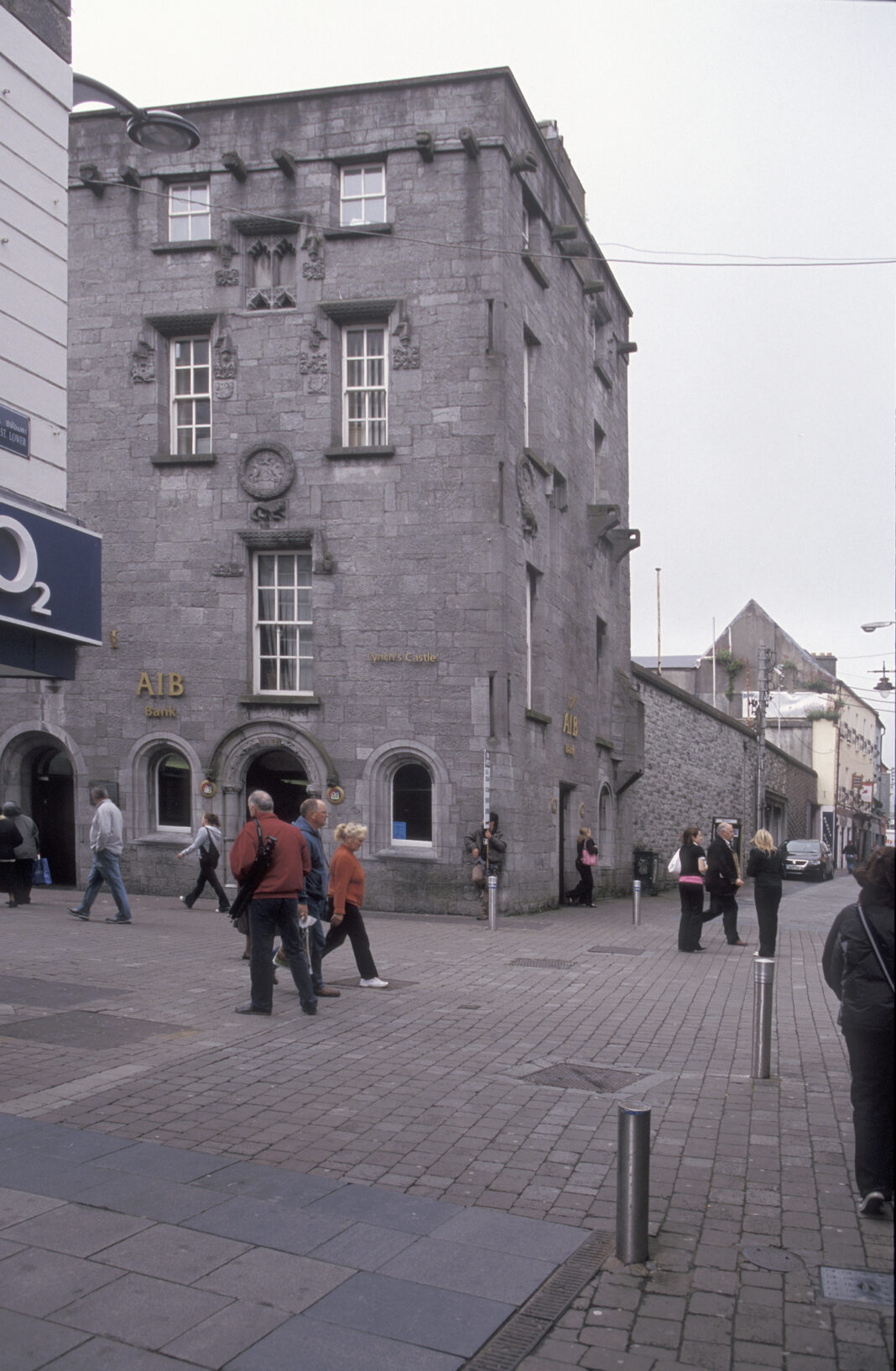
Galway’s busiest streets do not always advertise their age. On Shop Street, surrounded by shopfronts, cafés and the daily rush through the city centre, one building quietly carries the story of merchant Galway in its stone walls. Lynch’s Castle is not a remote ruin or a carefully isolated monument. It remains part of the working city, which is precisely what makes it so easy to miss and so rewarding to notice.
The building is traditionally associated with the Lynch family, one of the fourteen merchant families remembered as the Tribes of Galway. Its surviving façade offers a rare glimpse of the fortified townhouses built by wealthy urban families when Galway was a prosperous Atlantic port.
A castle in the middle of Shop Street
Despite its name, Lynch’s Castle is better understood as a fortified urban townhouse than a countryside fortress. Its strong limestone construction, narrow openings, carved details and defensive character reflected both wealth and the need for security inside a walled medieval town.
The present building contains work from different periods. Much of the surviving structure is generally dated to the late fifteenth and early sixteenth centuries, when Galway’s merchant families were deeply involved in trade with Britain and continental Europe. The building’s position close to the commercial heart of the town would have been as useful then as it is today.
Look closely at the stonework
The most interesting details are above street level. Visitors should look for carved coats of arms, decorative window surrounds and stone features linked with the Lynch family and other powerful Galway families. The façade was restored in the twentieth century, helping to preserve features that might otherwise have disappeared behind later alterations.
This is a good example of why Galway rewards people who occasionally look up. The modern shopfront occupies attention at pavement level, while the older city survives overhead.
The story of Mayor James Lynch
A grim local story is often connected with the building. According to tradition, Mayor James Lynch FitzStephen condemned and hanged his own son in 1493 after a murder. Versions differ, and parts of the tale belong to later folklore rather than securely documented fact. The better-known memorial connected with the story is Lynch’s Memorial Window on Market Street, not the present bank façade itself.
The legend should therefore be treated as part of Galway’s storytelling tradition rather than a perfectly settled historical account. It remains powerful because it combines civic duty, family tragedy and the severe justice associated with the medieval town.
Can you go inside?
Lynch’s Castle is used as a bank, so it is not operated as a conventional visitor attraction. Access can depend on normal business arrangements and opening times. The exterior, however, can be viewed freely from Shop Street, and the façade is the main reason to stop.
A short visit works particularly well as part of a historic city-centre walk linking Eyre Square, Shop Street, St Nicholas’ Collegiate Church, the medieval wall remains and the Spanish Arch.
Good to know before you visit
- The building stands directly on busy Shop Street.
- The best architectural details are above the modern ground-floor frontage.
- Allow about ten minutes for the exterior, longer if combining it with nearby sites.
- Shop Street is pedestrianised for much of the day and is easiest to reach on foot.
- This is a functioning commercial building rather than a museum.
Why Lynch’s Castle matters
Lynch’s Castle compresses several centuries of Galway into one address. It represents the merchant families who governed the town, the importance of overseas trade and the practical strength of an urban house built within medieval walls. More than anything, it demonstrates how the historic city has been adapted rather than sealed away.
Frequently asked questions
Is Lynch’s Castle a real castle?
It is a fortified medieval townhouse. The word “castle” reflects its strong construction and defensive appearance, but it was an urban residence rather than a large military fortress.
Where is Lynch’s Castle?
It is on Shop Street in Galway city centre, a short walk from Eyre Square and St Nicholas’ Collegiate Church.
Is Lynch’s Castle free to visit?
The exterior can be viewed freely from the street. It is not run as a ticketed historic attraction.